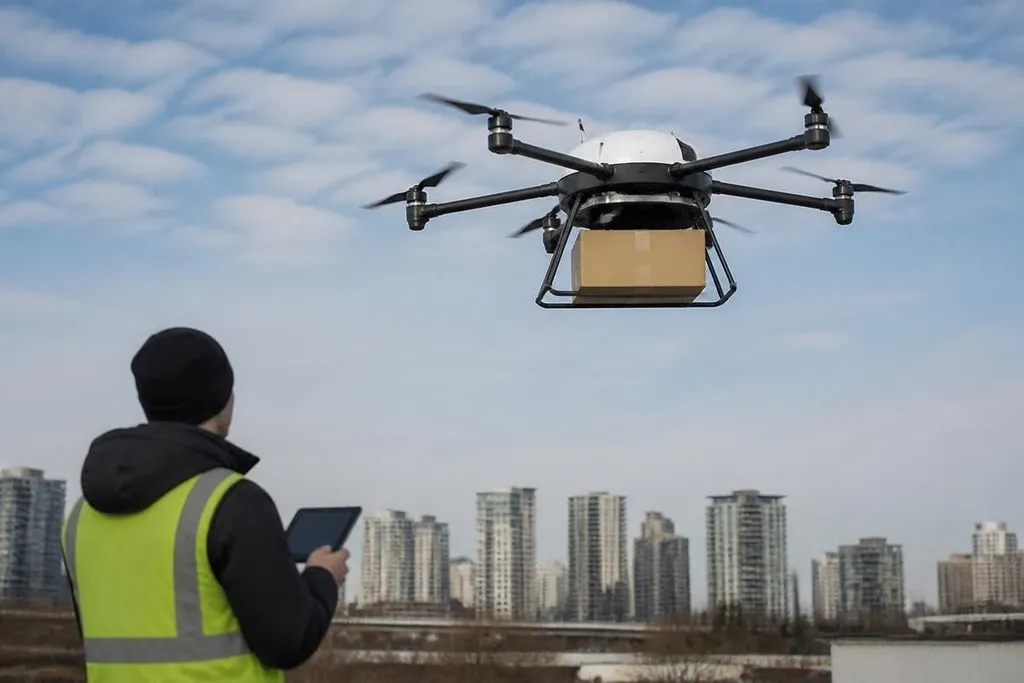
A delivery drone must do more than carry a parcel through the air. It must lift the load, avoid people and buildings, reach the right drop point, return safely, and fit into a working delivery network.
These aircraft will be judged by those tasks together. A longer flight time helps, but it can't fix poor weather handling, hard-to-service batteries, or a landing spot that isn't ready.
- Useful range: The drone needs enough battery for the route, reserve power, and a safe return.
- Safe handoff: The parcel must reach a known point without putting people below at risk.
- Proof in service: A short test flight says little about repeat trips, repairs, or bad weather.
The aircraft is only one part
A delivery drone usually combines electric motors, cameras or other sensors, a flight computer, a battery, and a system for carrying the parcel. Each part affects the others.
A larger battery adds weight, so the motors need more power, which can reduce the gain from the extra stored energy. That trade-off makes payload a more useful measure than flight time alone.
A drone that flies for hours without a parcel may be less useful than one that carries a small package on a repeatable route.
The handoff creates another engineering problem. The drone may lower a parcel on a cable, land at a marked site, or release the package from above. Each method needs a clear procedure for people, pets, vehicles, and loose objects near the drop point.
A system that works only when the ground is empty has a narrow use. A useful system needs a clear response when the chosen site is blocked or the package cannot be released safely.
Autonomy needs a human backup
Autonomy means the aircraft can handle parts of a flight without a pilot controlling every movement. That doesn't remove the need for people. A remote operator may still need to review an alert, approve a route change, or take control during a fault.
The useful question is not whether a drone is called autonomous. Ask which tasks it handles alone, which events trigger human control, and how long an operator has to respond.
For a team comparing delivery-drone projects, a flight claim needs its route, payload, date, weather, and control setup. When reading Robot24, look for those details before treating a short test as proof of a working delivery service.
The system also needs records. Operators should be able to check the planned route, battery state, weather limits, control events, and delivery result after each flight. Without those records, a failed drop becomes a story instead of a fixable engineering problem.
Weather and maintenance decide the work
Wind, rain, heat, cold, and poor visibility can change the work a drone can do. A route planned for calm air may need more battery reserve in stronger wind. Sensors can also collect water or dirt, and a cable or release mechanism can wear faster than the aircraft body.
That is why service work belongs in the design from the start. Operators need access to batteries, motors, propellers, sensors, and the parcel system. The aircraft also needs a way to report faults before a failed flight leaves a customer waiting.
I’d judge a delivery drone by its repeat trips and recovery procedures, not by its longest flight in a controlled test.
The evidence that matters should show how the system behaves after a missed landing, a weak battery, a blocked drop site, or a loss of its control link. A short demonstration can show that a flight is possible. It can't show how much staff time the service needs.
A practical buying checklist
Before backing a delivery-drone project, check these points:
- Route limits: Which distances, heights, weather conditions, and airspace rules apply?
- Parcel limits: Record the supported weight, size, shape, and packaging method.
- Drop procedure: Check what happens when the site is occupied or unsafe.
- Human control: Ask who can intervene and what information they see.
- Service plan: Confirm how batteries, motors, sensors, and release parts get replaced.
- Test record: Look for repeat flights and failed-case results, not a single clean demo.
Those answers show where the system can work today. They also show which claims still need proof.
Delivery drones will earn trust through repeatable routes, clear safety limits, and service records that survive a bad day. Until operators publish those details, the useful question remains simple: how many deliveries can the system complete before a person has to step in?